


By Jeremy Davis
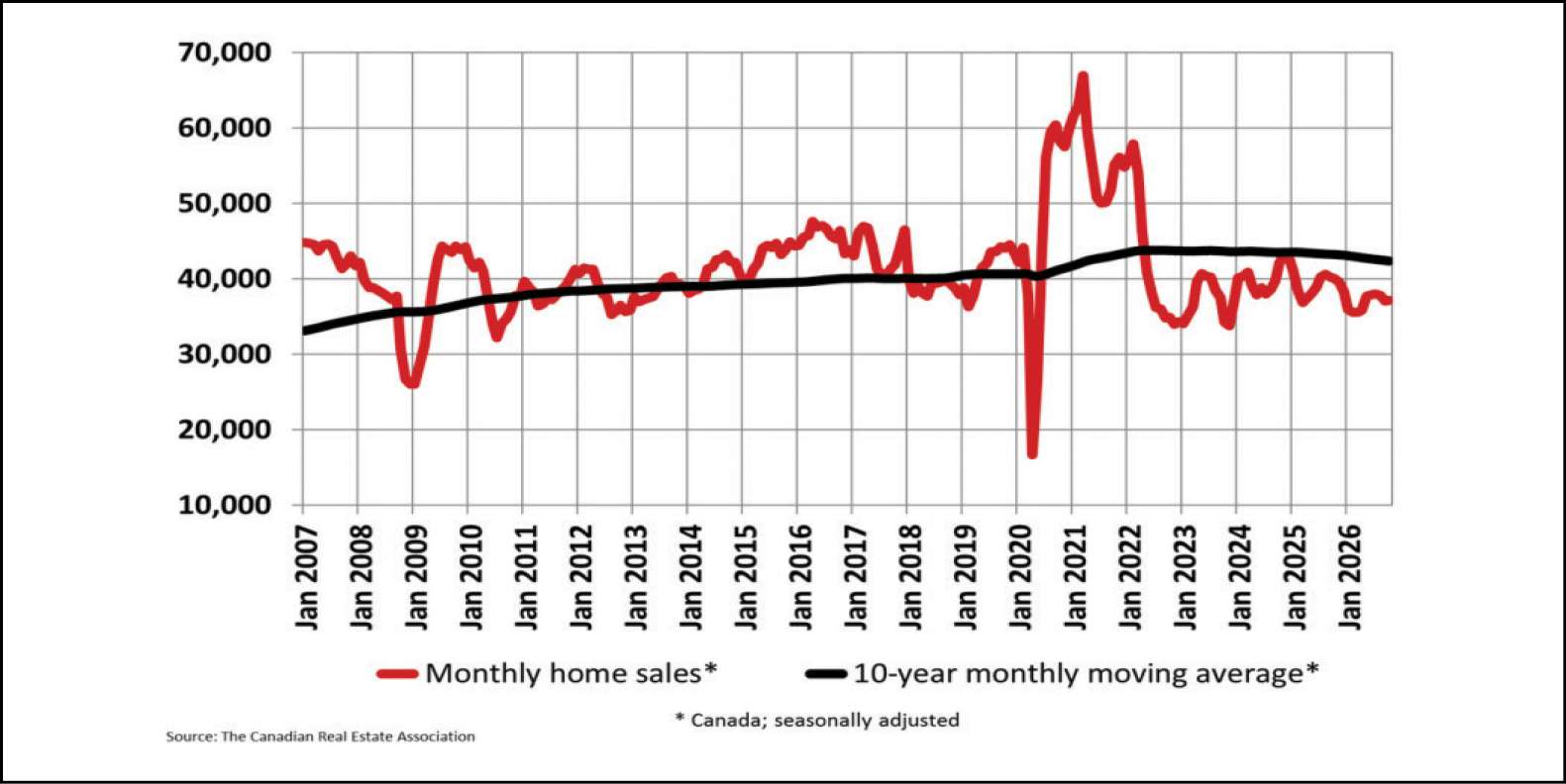
After a slower September, Canada’s housing market saw little movement in October 2026. Home sales edged just a bit higher, new listings increased slightly, and prices remained relatively stable compared with the previous month. But while the national numbers suggest a relatively steady market, Canadians are still buying fewer homes than they were a year ago.
According to the latest numbers released by the Canadian Real Estate Association (CREA) on November 17, 2026, here’s what Canadian home buyers, sellers, and homeowners should know at a glance:
• National home sales edged up 0.3% month-over-month.
• Actual (not seasonally adjusted) monthly activity came in 10.6% below October 2025.
• The number of newly listed properties rose 0.8% on a month-over-month basis.
• The actual (not seasonally adjusted) national average sale price dipped 1.6% on a year-over-year basis, hitting $678,584.
As a point of reference, here are the same statistics for the Winnipeg Regional Real Estate Board’s market region:
• Home sales across the market region were down 1% month-over-month
• Monthly activity was 7% below October 2025
• The number of new listings fell 12% month-over-month
• The average price of $455,860, a record for October, rose 3% from October 2025.
Home sales increased slightly in October
Following a 1.9% decline in September, national home sales increased by 0.3% in October, after adjusting for seasonal trends.
That’s a relatively small change, suggesting Canada’s housing market has remained fairly steady heading into the final months of 2026.
However, when comparing actual sales activity with the same month last year, the picture looks different. Across Canada, home sales were down 10.6% compared with October 2025.
What does the national housing market look like?
For the most part, Canada’s housing market remains balanced.
The number of newly listed properties increased 0.8% in October compared with September, slightly outpacing the increase in home sales. This brought the national sales-to-new-listings ratio to 48.7%, a slight drop from 49% in September.
Put simply, for every 100 properties newly listed for sale in October, there were approximately 49 home sales.
CREA generally considers a ratio between 45% and 65% consistent with balanced market conditions, meaning neither buyers nor sellers have a significant overall advantage.
There were also about 197,000 properties listed for sale across Canadian MLS® Systems at the end of October, slightly above the long-term average of 190,000.
That works out to roughly five months of housing inventory nationally. In simple terms, if no new homes were listed and sales continued at October’s pace, it would take around five months to sell the properties currently available.
Five months is right in line with Canada’s historical average. However, housing supply also varies by region and property type.
For example, Metro Vancouver had 15,688 properties listed for sale at the end of October. While that’s slightly fewer than a year ago, it’s 24% above the region’s 10-year seasonal average, suggesting buyers have more selection than usual for this time of year.
In Calgary, increased supply in the apartment and row-home markets has created more buyer-friendly conditions, while detached and semi-detached properties remain relatively balanced.
The takeaway? Canada’s housing market might be balanced nationally, but the amount of competition you’ll face can depend heavily on the neighbourhood and type of home you’re interested in.
What about interest rates?
Another important development in October was the Bank of Canada’s decision to increase its policy interest rate by 0.25 percentage points to 2.5% on October 28.
The increase was intended to help manage inflation concerns, particularly those associated with rising energy costs.
“In a widely expected move, the Bank of Canada raised its policy interest rate at its October 28 announcement with the goal of tamping down
Canadians’ concerns about creeping inflation stemming from higher energy costs,” said CREA’s Senior Economist Shaun Cathcart. “That said, with the Bank’s preferred inflation measures still very well behaved, this is unlikely to be a repeat of the 2022 tightening cycle. Rather, it is more likely to be of the mild to moderate variety, although that distinction does carry extra weight in times of stretched affordability.”
While the Bank of Canada’s policy rate isn’t the same as the mortgage rates offered by lenders, it can influence borrowing costs, particularly for
variable-rate mortgages.
For buyers, this creates an important consideration: even if home prices are lower than they were a year ago, higher borrowing costs can offset some of those savings.
For existing homeowners approaching a mortgage renewal, it also reinforces the importance of understanding how changing interest rates could affect future payments.
Since the rate announcement came near the end of October, its full impact on housing activity remains to be seen.
If you’re planning to buy or sell a home in 2027, understanding what’s happening in your local market is a great place to begin. A REALTOR® can help you interpret the numbers, understand the competition, and make decisions based on your goals.
Jeremy Davis is the Winnipeg Regional Real Estate Board’s Director of External Relations & Market Intelligence.