


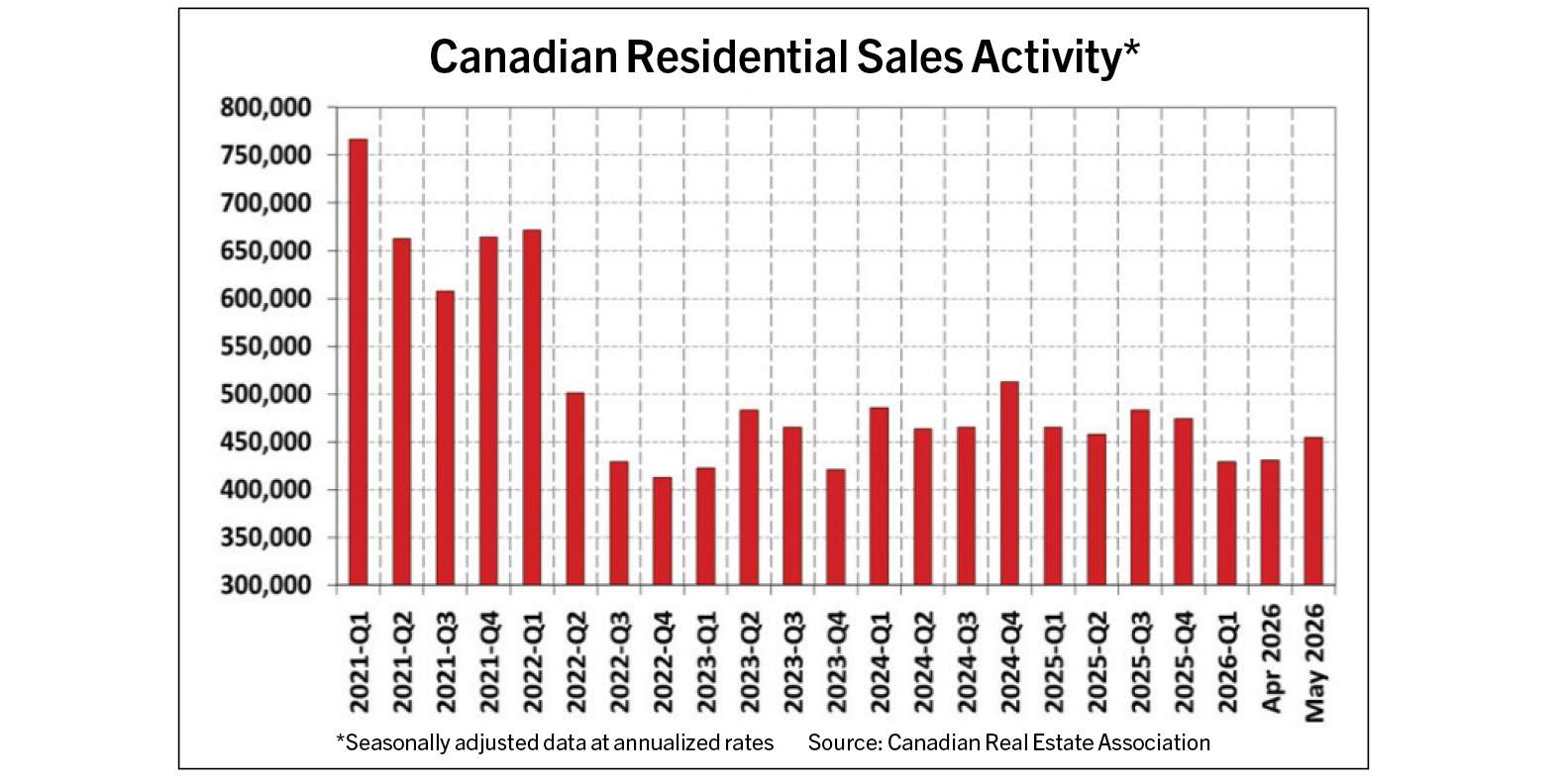
Canadian home sales popped up 5.5% in May, a move Canadian Real Estate Association (CREA) Senior Economist Shaun Cathcart said was a “good bounce.”
The latest data released Tuesday comes after months of slower-than-usual sales figures, and reinforces the notion that, historically, current price levels, interest rates and sales-to-new-listings ratio are actually favourable for Canadian home buyers.
“While it was just the first month in 2026 to see any meaningful upward momentum in headline demand, under the surface conditions have been improving for some time,” Cathcart says in the latest CREA monthly housing market report. “Sellers’ and buyers’ expectations are increasingly aligned, as evidenced by tightening sale-to-list price ratios and shorter periods between listing and sale dates. As a result, prices have largely stabilized following some softness earlier in the year.”
Before we get into analyzing what’s going on behind the scenes, here are the national numbers you need to know when comparing sales and price data to your local market:
• National home sales jumped 5.5% in May compared to April.
• The number of newly listed properties edged down 1% in May compared to April.
• The actual (not seasonally adjusted) national average sale price was up 1.5% on a year-over-year basis in May 2026, hitting $702,079.
This contrasts with the Winnipeg Regional Real Estate Board’s market region, which saw:
• All MLS® home sales rise 26% from April, the second consecutive month-over-month increase of this kind.
• New listings rose 3% from April.
• Residential detached average prices rose 4% year-over-year, increasing to $477,313.
What’s driving the recent rise in Canadian home sales?
Cathcart mentions there are a few factors that led to the jump in sales, but a growing sentiment among Canadians realizing this may be the bottom in terms of interest rates, prices and demand was enough motivation for some potential buyers to act.
The threat of a lingering war in the Middle East affecting Canada’s economy led to an increase in bond yields, which raised fixed mortgage rates by 30 to 40 basis points, peaking in April. Typically, mortgage rates going up reduces demand, but Cathcart explains that may have been enough of a signal for Canadians sitting on the sidelines that conditions are favourable now.
“I think (mortgage) rates going up a little bit may have been a wake-up call for some of these people who were just waiting, waiting, and waiting, going, ‘Oh, maybe that was the bottom,’ and jumping in,” he explains in the Housing Market Report video (watch it online at realtor.ca).
Homes aren’t selling right away, helping curb unrealistic expectations
With the Bank of Canada having already hinted that the expedited rate-cutting days are over, Canadian buyers are returning to their local real estate markets and also noticing that homes aren’t being bought as quickly.
Cathcart points to how there was a burst of new listings in early April, but that didn’t translate to a burst of home sales that month, either.
“There aren’t a lot of markets left in Canada where houses sell in a week,” Cathcart said, throwing it back to the frenetic buying and selling days experienced in 2021.
He said these days the median amount of time for a home to remain on the market is a more sustainable 23 or 24 days, which would help explain May’s pop in sales.
This has all contributed to tempered expectations in terms of pricing, too. Buyers and sellers are more aligned than in months past. Sellers are settling on more realistic list prices, and buyers are showing some more eagerness in comparison to January.
“What (a home) lists for and what it sells for are coming closer and closer together,” Cathcart said.
Some areas of Canada continue to see increased prices, even with national averages stabilizing
When looking at year-over-year data, regionally, prices remain down on a year-over-year basis in British Columbia, Alberta, and Ontario, offsetting major gains in other provinces such as Saskatchewan, Quebec and Newfoundland and Labrador.
“If you put home prices being at a bottom alongside interest rates, which now have a risk they could go higher, they’re not going to go lower, then those two things together are what make affordability,” Cathcart notes, saying he also sees a timeline where this scenario brings even more buyers off the sideline in the second half of the year.
“Like the weather in many parts of Canada this year, the spring market appears to have been delayed by a month or so, but the May numbers left little doubt that activity is now picking up,” said Garry Bhaura, CREA Chair and a REALTOR® in Brampton, Ont. “The handoff from May into June is typically the busiest time of the year, so we now have a strengthening market happening at the most active time of the year. If you have been on the fence this year as either a buyer or as a seller waiting for a sign, this could be it, and the first step in coming off the sidelines is to get in touch with a REALTOR® in your area.”
— REALTOR.ca