


The spring Canadian housing market didn’t exactly burst through the front door in April, but it did come knocking.
According to the latest data from the Canadian Real Estate Association (CREA), national home sales edged up 0.7% from March to April, while newly listed properties jumped 4.1% during that same time.
Similarly, the Winnipeg Regional Real Estate Board reports residential detached MLS® sales have continued to rise in its market region, well above the national average, up 26% from March to April. Conversely, residential detached MLS® sales remained 13% lower than last year, but in line with the 5-year averages.
Notably, April represented the first month on record when the residential detached average price for Winnipeg was above $500,000 while the average price across the region was just short of that mark.
It’s a sign that buyers aren’t rushing back into the market in a big way. With mortgage rates remaining elevated (compared to the ultra-low rates that started during the beginning of the pandemic), affordability is still a challenge in many parts of the country, and economic uncertainty continues to weigh on decision-making.
April’s numbers also suggest the market is showing signs of life. More listings are coming online, prices are showing signs of stabilizing, and CREA says days on market have been trending lower in recent months.
CREA’s April 2026 housing data:
• national home sales were up 0.7% from March;
• new listings rose 4.1% month over month;
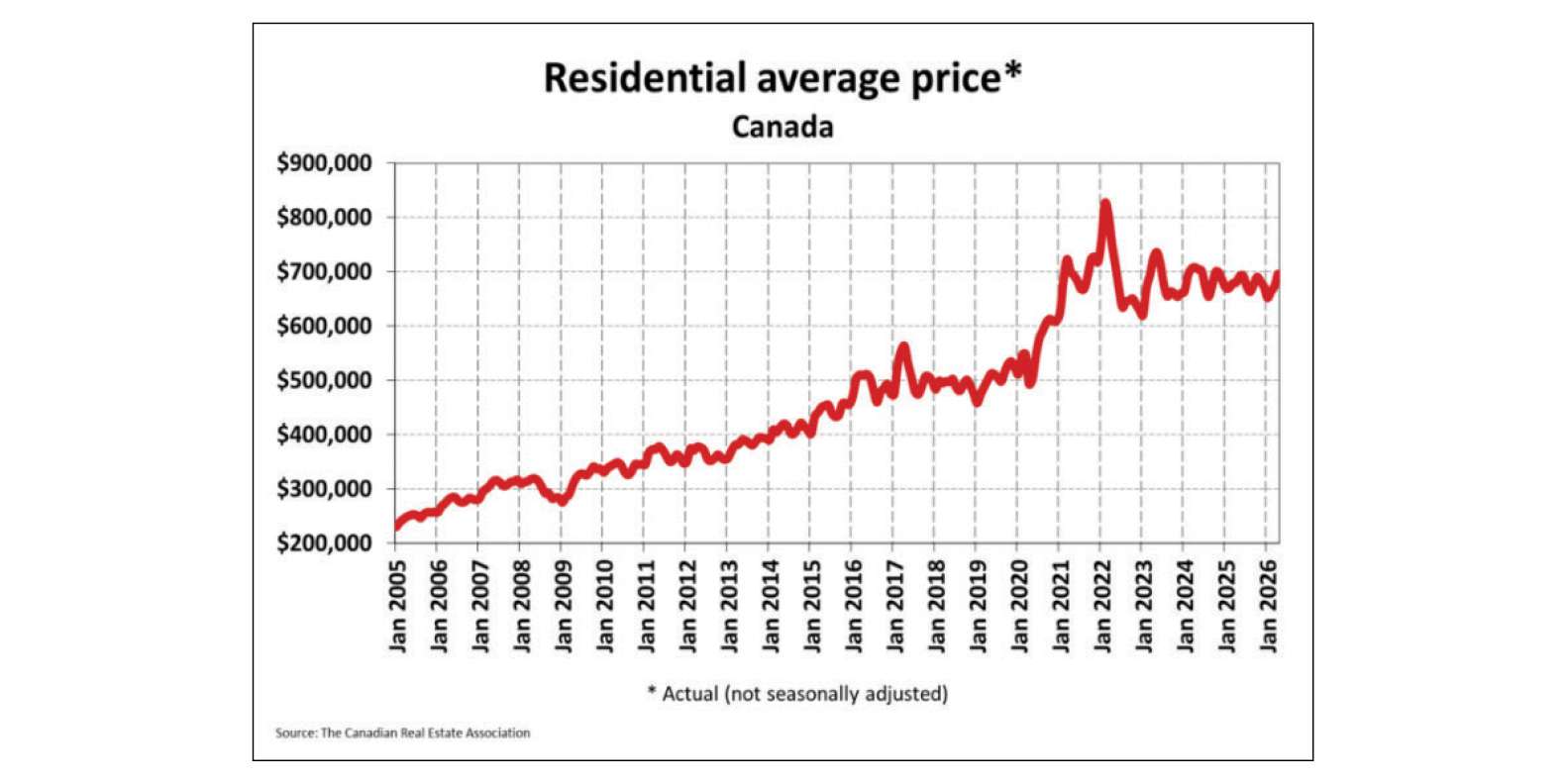
• the national average sale price was $695,412, up 2.2% from April 2025; and
• there were 187,647 properties listed for sale across Canadian MLS® Systems at the end of April.
More listings are helping keep markets balanced
The biggest April headline may not be the small bump in sales, rather the jump in new listings across Canada.
A 4.1% increase in newly listed properties means more choice at the time of year when many Canadians are actively watching the market. Spring is traditionally when inventory builds, and April delivered on that front.
More listings can give buyers more time to compare properties, revisit budgets, and make decisions without feeling like every home will be gone by the end of the week. It can also help reduce some of the pressures that defined the market during the peak pandemic years.
That doesn’t mean every buyer suddenly has the upper hand. Conditions vary a lot depending on the city, price point, property type and neighbourhood.
Nationally, the sales-to-new listings ratio eased to 45.6% in April, down from 47.1% in March. CREA reminds us that a number between roughly 45% and 65% are generally consistent with balanced market conditions.
So yes, April was technically still within balanced territory at a national level, but as always, regional markets can greatly vary from one to another.
What the housing data means for home buyers
If you’re a buyer, April’s data suggests there may be a bit more breathing room than we’ve seen in recent spring markets.
More listings can mean more options, and stabilizing prices may help buyers feel more confident about entering the market. Many buyers are still being careful, and for good reason. Mortgage rates remain a major factor in affordability, and even where prices have come down, monthly payments may still feel stretched.
But the current market may reward buyers who are prepared. That means knowing your budget, getting pre-approved, understanding what you can comfortably afford, and working with a REALTOR® who knows what’s happening in your local market.
Because while the national numbers are useful, your experience as a buyer will depend heavily on what’s happening in your neighbourhood and price range.
And with home sales showing the first signs of life this year (in terms of monthly tracking), it’s still a good time to buy as price points have found a footing and inventory isn’t stressed.
What rising sales and listings means for sellers
For sellers, April’s numbers are a reminder that buyers are still out there — they’re just more selective than they were a few years ago.
But this isn’t the kind of market where pricing high and waiting for a bidding war is likely to be the best strategy in every region.
With more listings coming onto the market, buyers have more to compare. That means a home that’s priced well, marketed well, and presented well is more likely to stand out.
It also means sellers may need to be realistic about timelines and expectations. The right buyer may be out there, but they may also be looking at several other properties before making a move.
A REALTOR® can help sellers understand what comparable homes are selling for, how long they’re taking to sell, and what buyers in that area are responding to.
Are home prices stabilizing?
One of the more notable pieces of April’s data was the MLS® Home Price Index (HPI). The HPI, according to CREA, is a sophisticated statistical tool used to measure real estate price levels and trends across Canada. CREA claims it’s widely considered the most accurate and stable gauge of the Canadian housing market
The National Composite MLS® HPI edged down just 0.1% from March to April, and that’s the smallest monthly decline since October 2025.
After several months of downward pressure, a smaller decline can suggest the market is beginning to find a floor. CREA also pointed to tightening sale-to-list price ratios and fewer days on market as signs prices may be stabilizing.
Regional housing trends
Canada’s many local markets aren’t all moving in the same direction. CREA noted prices remain down year over year in B.C., Alberta, and Ontario, while gains in other provinces helped offset those declines nationally.
In the Vancouver area, one of Canada’s most expensive housing markets, Greater Vancouver REALTORS® says April sales were down 2.5% compared to the same month last year. That points to continued caution among buyers in higher-priced markets, where affordability remains a major hurdle.
In the Greater Toronto Area, the picture was a bit more mixed. The Toronto Regional Real Estate Board says sales were up 7% year-over-year in April, but activity remained well below levels seen in April 2024. Average prices were also down almost 5% from April 2025, landing at $1,051,969.
Meanwhile, more affordable regions in parts of the country continue to hold up better, helped by different supply-and-demand dynamics.
What happens next?
The rest of the spring market will be important.
CREA has already lowered its 2026 forecast, now expecting national home sales to rise by about 1% compared to 2025. That’s a much more muted outlook than earlier expectations for a stronger rebound.
April showed a few encouraging signs: sales edged higher, listings increased, days on market moved lower, and prices showed signs of stabilizing.
That may not be the dramatic comeback some were expecting at the start of the year, but for buyers, sellers, and homeowners, a more stable market can still be welcome news.
— REALTOR.ca