


The Bank of Canada hit pause again, holding its policy rate at 2.25% and choosing stability at a time when the global economy is anything but.
On the surface, this may feel like more of the same as Canada’s central bank has now kept the same rate since October 2025, reinforcing a pattern that’s been building for months.
However, last week’s decision comes with a slightly different backdrop than previous announcements.
In his opening remarks to the press following the release of the announcement, Governor Tiff Macklem outlined some of the challenges the Bank faces, stating: “Economic weakness combined with rising inflation is a dilemma for central banks. Raising interest rates to slow inflation could further weaken the economy. Easing interest rates to support growth risks pushing inflation well above target.”
Among rising geopolitical tensions tied to the conflict in Iran, the outlook on energy prices and the general economy, the Bank of Canada is navigating a more complicated economic picture than it was even a few weeks ago.
The Bank noted that global bond yields had risen, which risks a rise in mortgage rates at some point, as fixed rates are based on the bond market.
Here’s what Canadians thinking about buying, selling or renewing a mortgage need to know right now.
What should home buyers know about the latest rate hold from the Bank of Canada?
While earlier rate cuts helped bring borrowing costs down from their 2024 highs, a new wave of global uncertainty is complicating the outlook. Rising geopolitical tensions and surging oil prices are pushing inflation risks back into focus, making central banks more cautious. There are even talks about potential rate hikes in the future if things continue to escalate.
For now, though, fixed rate mortgages are likely to remain relatively stable, while variable rates may not see any meaningful declines any time soon.
As of the morning of March 18, 2026, RBC is offering a five-year fixed closed term mortgage (the most popular choice among Canadian homeowners) starting at 4.59%, and a five-year variable closed term is advertised at 3.95%. Ratehub.ca is offering five-year variable rates as low as 3.35%.
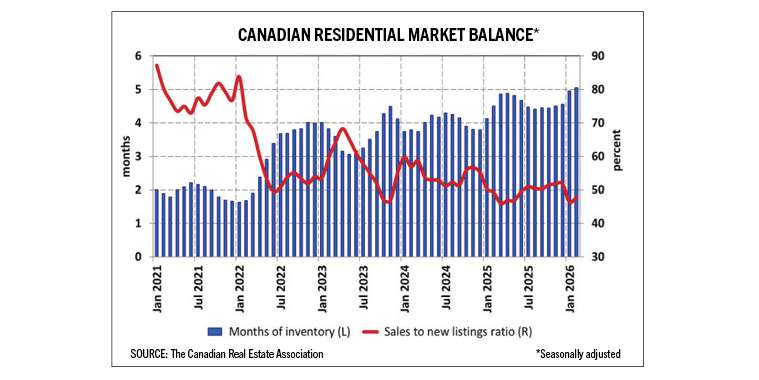
The latest data from the Canadian Real Estate Association (CREA) shows favourable opportunities are emerging for buyers in certain markets, especially with home sales down, new supply rising and interest rates stabilized.
With fewer bidding wars and more time to make decisions right now, buyers may feel less pressure and have more negotiating power. Waiting for dramatically lower rates may not be the strategy it once was. Instead, buyers may want to focus on whether today’s prices and monthly payments fit their long-term plans — before any potential spring market boom hits.
“Lots of listings coming out the second half of February, and it looks like a lot of them are selling, so I don’t think things are going to stay as slow as they have been,” Cathcart said in the CREA Housing Market Report.
What sellers should know right now
For sellers, last week’s announcement is another signal that the market is being shaped more by fundamentals than momentum.
Stable rates help support buyer confidence, but they don’t automatically drive prices higher, especially in a market where affordability is still top of mind.
Across Canada, inventory has been trending upward compared to the tighter conditions seen in 2021 and 2022. In many Canadian housing markets, months of inventory have moved back toward balanced or on the cusp of buyer-friendly territory, giving people who want to buy a home more choice and leverage. At the same time, sales activity hasn’t accelerated at the same pace, which is keeping price growth more measured.
What the decision from the Bank of Canada means for homeowners and renewals
If you’re a homeowner approaching renewal, last week’s rate hold brings a bit of clarity, just not much relief.
Even with rates now stable, many Canadians are still facing higher payments compared to the ultra-low rates they locked in several years ago.
And with the Bank of Canada signaling caution due to global risks, significant rate cuts in the near term look less certain. Some homeowners are exploring renewal options earlier and may want to consider adjusting their amortization or payment structures.
Uncertainty is back in the spotlight
Last week’s rate decision doesn’t dramatically change the direction of Canada’s housing market, but it does reinforce the environment we’re in.
Interest rates are stable, economic uncertainty is elevated, and the national housing market is adjusting accordingly.
Whether you’re buying, selling or renewing, the key isn’t trying to predict the next rate move, rather, it’s about making informed decisions based on current conditions. There are windows of opportunity for buyers focused on major urban centres, but of course, your best option is to consult with a REALTOR® before making your next move.
— REALTOR.ca