


By Jeremy Davis
A highlight from last week’s 2026 Market Insights event was that the Winnipeg Regional Real Estate Board’s (WRREB) market region saw increased MLS® sales in 2025 while larger markets across Canada saw decreases when compared to 2024.
With moderate but steady increases to MLS® sales, WRREB’s real estate market performance moved against the grain from markets like Toronto, Vancouver and Calgary which saw double-digit decreases. This was a good reminder that all markets are local, and the dynamics occurring in one area may not represent what’s happening in another when looking across Canada.
In January, our market region saw increases to average prices and decreased MLS® sales to start off 2026. For this week’s Real Estate Market Matters column, let’s take a look at what happened nationally for January, according to REALTOR.ca:
Canadian home sales dip
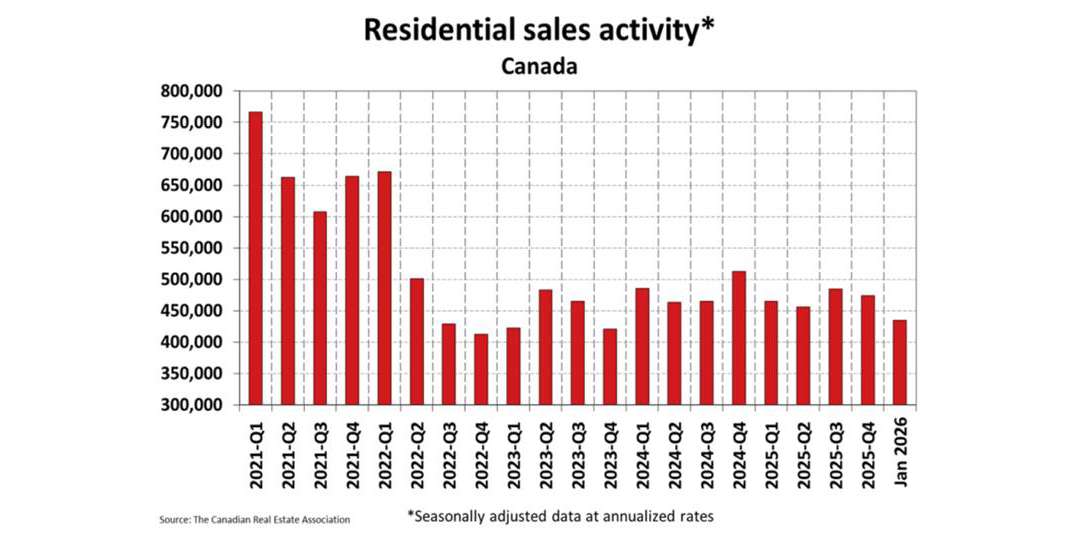
Canadian home sales dipped 5.8% in January, and the “why” behind it isn’t your typical market storyline.
The Canadian Real Estate Association (CREA) says you can blame a mid-month snowstorm in
the Greater Golden Horseshoe and Southwestern Ontario for the noticeable dip in sales.
“That’s a big drop for a single month,” said CREA Senior Economist Shaun Cathcart on this month’s Housing Market Report. “It only took me a second to then realize, ‘Wait a second. Didn’t the most populated chunk of central Canada get dumped with two feet of snow in the third week of January?’”
Cathcart went on to explain that the story for this time around was probably more about a historic winter storm than a downshift in demand.
“It’s not a fundamental drop in demand, it’s a logistical drop in demand,” he said. “I don’t think it’s an indication that things are going down. It’s just… a snowstorm.”
Hey, we get it. Who would want to move their furniture and appliances through suitcase-high snowpacks?
Before we get into more of the latest CREA data, here’s what you need to know about Canada’s real estate markets:
• National home sales declined 5.8% month-over-month.
• Actual (not seasonally adjusted) monthly activity came in 16.2% below January 2025.
• The number of newly listed properties jumped 7.3% on a month-over-month basis.
• The actual (not seasonally adjusted) national average sale price dipped 2.6% on a year-over-year basis in January 2026.
New listings jumped even though home sales fell
For first-time home buyers hoping to enter the real estate market this year, this is the news you want to see more. As more listings become available, there’s a sweet spot where the demand for supply lessens, and that can help bring down prices.
Similar to what happened in January 2025, new supply jumped on a month-over-month basis in January 2026, rising 7.3% as sellers seemed eager to get the year started.
The burst of new supply was driven by about two-thirds of local markets, and led by Montreal, Quebec City, Calgary, Greater Vancouver, and Victoria. Meanwhile, Central and Southwestern Ontario, in many cases, recorded declines. This reinforces Cathcart’s view that winter weather was a primary factor in January in those regions, as it appears to have suppressed both demand and supply.
With a rare combination of a sizeable increase in new listings and a sharp slowdown in sales in January, the national sales-to-new listings ratio dropped to 45% compared to 51.3% at the end of 2025. Readings between 45% and 65% are generally consistent with balanced housing market conditions. Anything below 45% and we enter a buyers’ market at the national level.
There were 140,680 properties listed for sale on Canadian MLS® Systems at the end of January 2026, up 4.5% from a year earlier, but 11.4% below the long-term average for this time of year.
It wasn’t that long ago the average price of a home in Canada was soaring. In February 2022, we hit a peak average price of $825,617. The latest data from CREA shows the latest non-seasonally adjusted average was $652,941 in January. That’s a 2.6% decrease from the same time last year.
Regionally, prices remain down on a year-over-year basis in British Columbia, Alberta, and Ontario, offsetting gains in other provinces. An analysis by city shows the largest year-over-year declines dipping into double digits in Hamilton-Burlington and Oakville-Milton, contrasted by double-digit gains recorded in Sudbury, Quebec City, and St. John’s, Newfoundland.
“Weaker market conditions, even if it’s temporary, does tend to affect pricing,” Cathcart explained in the Housing Market Report.
Four reasons why we can expect to see more first-time home buyers in 2026
Cathcart said he believes there will be many first-time home buyers entering the market this year. In the Housing Market Report, he gives four reasons as to why:
• The population aged 25 to 40 is currently the largest demographic group in Canada’s history, representing a significant pool of potential first-time home buyers.
• This demographic has been unable to enter the market for the past four years due to intense competition (remember those wild pandemic times?) and high interest rates from 2022 to 2024, which made passing stress tests difficult.
• The Bank of Canada has indicated that rate cuts are likely (mostly) finished, and bond markets suggest fixed rates will remain around 4%. This provides a clear window for buyers who have been waiting for rates to stabilize.
• Surveys show that 75% to 85% of non-homeowners aged 25 to 40 still aspire to own a home, indicating a strong desire for homeownership rather than renting long-term.
As always, if you’re thinking about buying a home this year, one of your first moves to make should be finding a REALTOR®.
Jeremy Davis is the Winnipeg Regional Real Estate Board’s Director of External Relations & Market Intelligence.